
Tortilla Flat Reflections

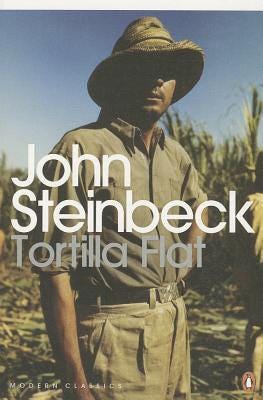
Tortilla Flat has garnered a range of critical evaluations over the years. Here’s a sampling:
“Tortilla Flat is a little masterpiece of the group portrait, a comic idyll of the underprivileged. Steinbeck deals with his paisanos as if they were characters out of Malory—knights living by a code that is both absurd and touching. Yet the elegance with which he shapes their adventures gives them the dignity of legend. They steal, they drink, they drift, but all within a pattern of honor recognizable and even admirable. What keeps it from sentimentality is the author’s exact ear and steady tone, which suggests that this is less a realistic picture than a tale told with affection and irony together.”
Edmund Wilson, The Boys in the Back Room: Notes on California Novelists, 1941.
“In Tortilla Flat Steinbeck attempted to present a community whose very poverty becomes the substance of its freedom. The paisanos’ rejection of property, ambition, and responsibility allows them to escape the spiritual aridity of the middle class. Yet the novel also runs the risk of turning deprivation into spectacle. The laughter and lyricism with which Steinbeck paints Danny and his friends can obscure the coercive social and economic structures that make such a life precarious. It is a book full of lightness, but one in which the shadows are never fully admitted.”
Warren French, John Steinbeck’s Fiction Revisited (Twayne, 1994), pp. 32–35.
“Tortilla Flat is a pastoral of poverty in which deprivation is transformed into camaraderie and spiritual abundance. By treating the paisanos as figures of myth and comedy, Steinbeck suggests that their marginality frees them from the corruptions of the dominant culture. Yet this pastoralizing vision is also its danger: it invites the reader to enjoy a world that cannot defend itself, a world whose political and ethnic realities disappear behind the haze of legend and laughter. The charm of the novel is inseparable from this act of erasure.”
Louis Owens, John Steinbeck’s Re-Vision of America (University of Georgia Press, 1985), pp. 38–40.
“The narrative voice of Tortilla Flat adopts the rhythms of romance, invoking the language of chivalric quest in order to describe small thefts, drunken feasts, and improvised loyalties. This stylistic inversion is central to the book’s effect. Steinbeck elevates the ordinary not by denying its ordinariness but by framing it within a tone of mock-heroic epic. The result is a work that hovers between affection and parody: an affectionate burlesque which nonetheless suggests the enduring human need for fellowship, ritual, and myth-making.”
Robert Murray Davis, “Steinbeck and the Comic Tradition,” in The Cambridge Companion to John Steinbeck, ed. Gillian Osborne (Cambridge University Press, 1996), pp. 57–60.
“In Tortilla Flat, Steinbeck draws upon Mexican and Spanish folkloric traditions—the trickster tale, the compadre bond, the communal feast—to construct a world where resourcefulness and generosity appear to flourish despite poverty. The novel’s humor and lyricism derive from this folkloric grounding. At the same time, the women of the novel are flattened into types—the temptress, the caregiver, the background presence—and the social and political vulnerabilities of the paisano community are rendered picturesque. Steinbeck’s admiration is genuine, but his mythic frame turns lived cultural practice into spectacle.”
María Herrera-Sobek, “John Steinbeck and the Mexican Connection,” Steinbeck Review 1.2 (2004): 7–12.
“Steinbeck’s Tortilla Flat participates in what might be called the ‘hemispheric pastoral,’ where cultural others are positioned as bearers of premodern virtue and communal wisdom. The paisanos are rendered as figures outside capitalist time and national history, living in a zone of leisure, improvisation, and festive abundance. This is what gives the novel its utopian warmth. Yet this warmth depends on forgetting the colonial and labor histories that produced the Monterey peninsula’s class and racial hierarchies. The novel is a dream of community sustained by historical amnesia.”
José David Saldívar, The Dialectics of Our America: Genealogy, Cultural Critique, and Literary History (Duke University Press, 1991), pp. 121–123.